

Nobel Laureates 2026: Advancing Knowledge, Inspiring Innovation

The 2026 Nobel Prizes recognise work across six fields, from neuroscience and astrophysics to literature, international law and economic policy. This year’s Nobel laureates include researchers who have opened new ways to study the brain and the universe, a writer whose work reimagines literary traditions, and a jurist whose career has advanced international justice.
Among the stories attracting particular interest for eLanka readers is the Nobel Peace Prize awarded to Navanethem “Navi” Pillay. Born in South Africa to a family of Indian Tamil descent, Pillay is not Sri Lankan, but her Tamil heritage and decades of work on human rights and accountability resonate with many in the Sri Lankan Tamil diaspora and with readers following international justice.
Medicine: Optogenetics reveals new ways to study the brain
Karl Deisseroth, Peter Hegemann and Georg Nagel received the 2026 Nobel Prize in Physiology or Medicine for discoveries concerning light-gated ion channels and optogenetics.
Optogenetics uses light-sensitive proteins to let researchers switch the activity of selected nerve cells on or off. In practical terms, it gives scientists a way to examine how particular brain cells and circuits contribute to functions such as movement, memory and behaviour.
The approach has transformed neuroscience research. By helping scientists investigate how neuronal circuits work, it supports a deeper understanding of the brain and may inform future research into neurological and psychiatric conditions. It is a research tool, rather than a treatment in itself.

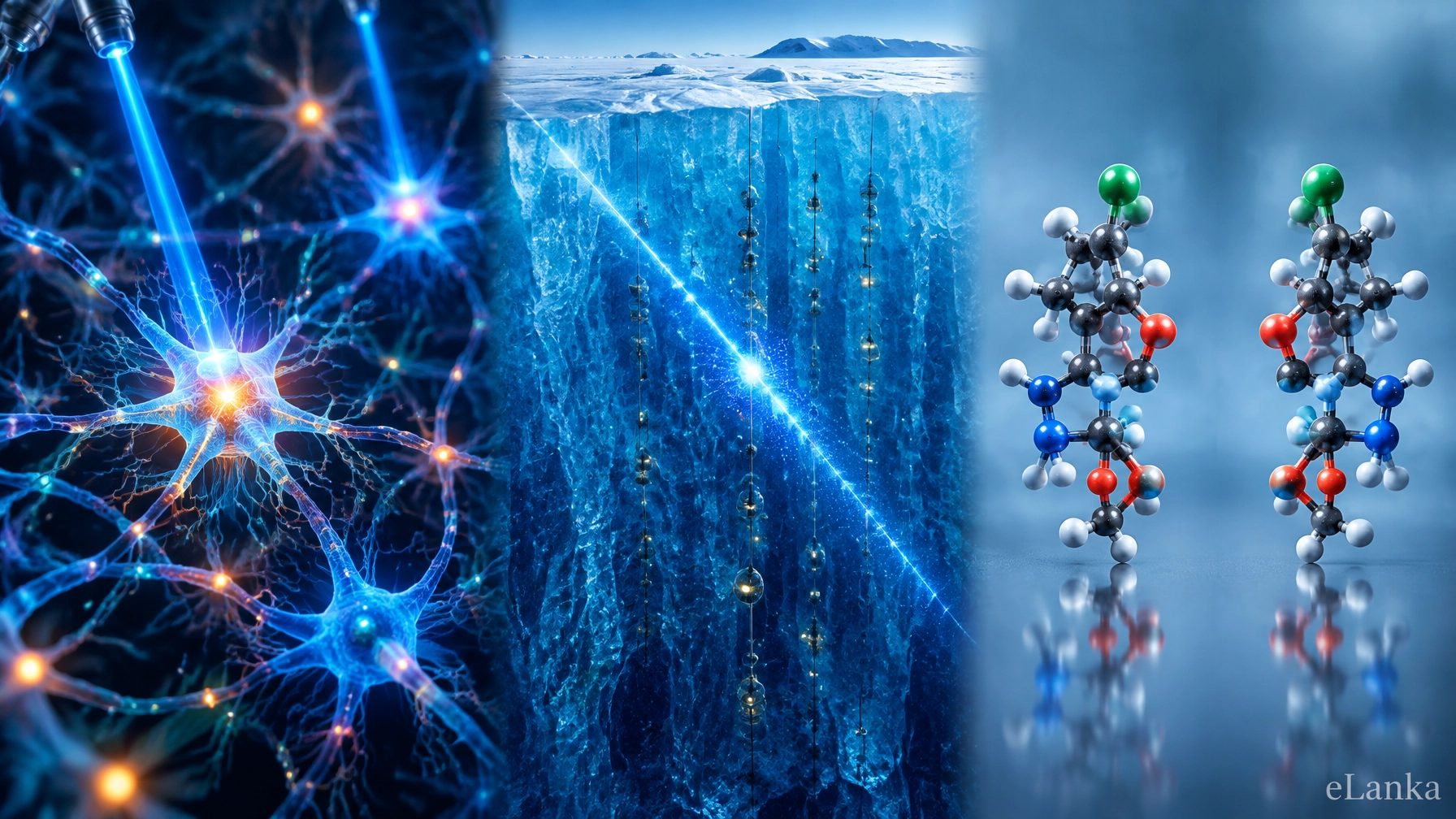
AI-generated editorial illustration. It does not depict the laureates or an official Nobel image.
Physics: Antarctic ice helps detect distant cosmic particles
Francis Halzen was awarded the Nobel Prize in Physics for decisive contributions to the IceCube Neutrino Observatory and the discovery of high-energy neutrinos of astrophysical origin.
Neutrinos are tiny particles that can travel across vast distances through matter with little interaction. IceCube uses a large volume of Antarctic ice, instrumented with light sensors deep below the surface, to detect signals produced when neutrinos interact with the ice.
The observatory allows scientists to investigate some of the universe’s most energetic processes. Its findings provide a new way to study distant cosmic sources that cannot be fully understood through light alone.
Chemistry: Understanding molecular mirror images
Henri B. Kagan and Kenso Soai shared the Nobel Prize in Chemistry for the discovery of non-linear effects and autocatalysis in asymmetric organic synthesis.
Some molecules occur in two forms that are mirror images of one another. Although the forms may look similar, they can behave differently in living organisms. This is important in medicine, where the specific form of a molecule can affect how it interacts with the body.
Kagan and Soai’s work helped explain how one molecular form can become dominant during a chemical process. Their findings have advanced understanding of asymmetric synthesis, the selective production of one form rather than its mirror image, and have implications for chemistry and the development of medicines.
Literature: Anne Carson creates new forms for contemporary writing
Canadian poet and classicist Anne Carson received the 2026 Nobel Prize in Literature for her bold and inventive body of work, which engages with classical traditions while creating new forms for contemporary literature.
Carson’s writing draws on ancient authors, mythology, translation and the history of words. The Nobel recognition highlights how she brings these traditions into conversation with modern literary forms, combining scholarly curiosity with creative experimentation.

AI-generated editorial illustration; no laureate is depicted.
Peace: Navi Pillay recognised for promoting international law
The 2026 Nobel Peace Prize was awarded to Navanethem “Navi” Pillay for her efforts to promote peace and international law. The award recognises her contribution to justice and accountability for war crimes, crimes against humanity and genocide.
Pillay was born in Durban, South Africa, in 1941, and is of Indian Tamil heritage. Her background is South African, not Sri Lankan, but her Tamil heritage gives this award a particular point of connection for many Tamil communities around the world, including Sri Lankan Tamil communities in the UK, Canada, New Zealand and elsewhere.
Her legal career has included senior roles in South African and international institutions. Pillay served as president of the International Criminal Tribunal for Rwanda, where she was involved in landmark jurisprudence establishing that rape and sexual violence can constitute genocide when committed with the intent to destroy a protected group. The tribunal’s 1998 Akayesu judgment is widely recognised as a significant development in international law.
Pillay later served as a judge of the International Criminal Court and as United Nations High Commissioner for Human Rights from 2008 to 2014. In that role, she advocated for human rights and accountability. Her work across these institutions reflects the importance of legal processes in documenting serious violations and seeking justice for victims.
For Sri Lankan Tamil diaspora readers, the recognition may prompt reflection on the wider role of international law in addressing conflict and protecting human rights. Pillay’s award is for her own record and service; her South African identity and Tamil heritage should not be confused with Sri Lankan nationality.

AI-generated editorial illustration; it contains no official emblem or identifiable person.
Economic Sciences: Research on stabilising economic fluctuations
Robert E. Hall and Michael Woodford shared the Sveriges Riksbank Prize in Economic Sciences in Memory of Alfred Nobel for work on the microeconomic foundations of macroeconomic stabilisation.
Their research helps explain how decisions made by households and businesses relate to the wider economy, and how monetary and fiscal policies can help manage economic fluctuations. In plain terms, it provides tools for understanding how policy choices may affect periods of growth and slowdown.
This work contributes to the models used by central banks and finance ministries when assessing economic conditions and considering measures to support stability.

AI-generated editorial illustration.
Recognising research, creativity and public service
The Nobel laureates 2026 demonstrate the breadth of work that can advance knowledge and contribute to society. Their achievements range from new ways of studying the brain and distant parts of the universe to research in chemistry, literary innovation, international justice and economic policy.
The awards also underline the value of sustained investment in research, education and institutions. Supporting scientific excellence and creative work helps communities address global challenges and build a more sustainable and prosperous future. By pushing the boundaries of knowledge, researchers and innovators continue to inspire new ideas and open possibilities for generations to come.
Readers can explore more community and cultural coverage in eLanka’s articles section.
Sources
The facts and award citations in this article were checked against the official Nobel Prize 2026 laureates page, the United Nations profile of Navi Pillay and The Hindu’s profile of Pillay. Further reporting: AP News’ Nobel winners round-up. The Mauritius Research and Innovation Council’s LinkedIn post was provided as background but could not be retrieved for independent review.
Original source: Nobel Prize 2026, all laureates.
At eLanka, we respect the rights of creators. If we have used an image you own and you’d like it removed, please email us at info@elanka.com.au and we’ll handle it promptly.
Thanks.
eLanka team
eLanka Disclaimer
Content published on eLanka may be created by the eLanka team, submitted by contributors or third parties, reproduced or adapted from other sources with appropriate source acknowledgement, or provided as promotional/advertising material by our clients. While eLanka takes reasonable care in preparing and publishing content, we do not warrant its completeness or accuracy. Views expressed are those of the respective authors or contributors and do not necessarily represent the views of eLanka. Third-party contributors, content providers and advertisers are responsible for the accuracy of material they supply and for ensuring they hold the necessary rights and permissions for its publication. Advertising and promotional content should not be regarded as an endorsement by eLanka of any product, service or claim.