

Veera Puran Appu: The Moratuwa-Born Leader of the 1848 Matale Rebellion

Illustration, not a historical photograph. The figure is an imagined depiction and is not intended to represent Puran Appu’s actual appearance.
Veera Puran Appu is remembered as one of the leading figures of the 1848 Matale Rebellion, an uprising against British colonial rule in Sri Lanka. Born in Moratuwa, he became a military leader in a movement that brought together rural grievances, resistance to new taxes and demands for the restoration of an indigenous monarchy.
A tribute by Senake (also known as Seneca) Bandara Godamunne, shared on eLanka on 10 November 2026, recalls Puran Appu’s life and sacrifice. It also preserves family and community accounts that should be read alongside the historical record. The dates most closely associated with his leadership and death are 26 July and 8 August 1848 — not November; the November date marks the publication of the tribute.
At a glance
- Veera Puran Appu: 1812–1848; born in Moratuwa.
- Marriage: Bandara Menike, daughter of Gunnepana Arachchi of Kandy, in early 1847, according to Godamunne’s tribute.
- Appointment: Prime Minister and Sword Bearer of the King at Dambulla on 26 July 1848.
- Rebellion: A principal leader of the Matale Rebellion against the colonial administration of Governor Viscount Torrington.
- Death: Executed by firing squad on 8 August 1848, aged 35. Standard accounts place the execution at Bogambara in Kandy; Godamunne’s tribute also describes graves at Matale cemetery.
- Gongalegoda Banda: Consecrated king on 26 July 1848. The tribute gives his title as “Sri Wickrama Siddhipathi”; AmazingLanka records the fuller title “Sri Wickrama Subha Sarva Siddhi Rajasinghe”.
A Moratuwa-born leader
The eLanka tribute gives Puran Appu’s full name as “Weera Sanadhdhana Weera Bala Patabendi Fransisco Fernando” and identifies him as a son of Moratuwa. Historical sources record variations in his name. Wikipedia’s article on Puran Appu gives his birth name as Wannaku Achchige Pudya Perera Francisco Fernando, while other accounts use Francisco or Fransisco Fernando. The spelling in the tribute is therefore presented here as the contributor’s version, rather than as a universally agreed form.
Godamunne’s post says Puran Appu met and married Bandara Menike, daughter of Gunnepana Arachchi of Kandy, in early 1847. The detail offers a glimpse of the personal ties behind the public story: a man associated with Moratuwa whose life became closely connected with the Kandyan region at a period of political upheaval.
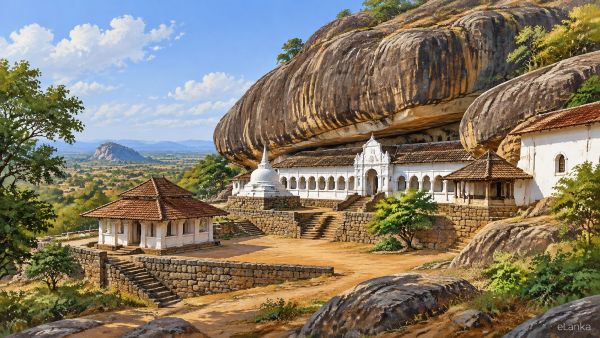
Dambulla, 26 July 1848: a new king and a new role
On 26 July 1848, Gongalegoda Banda was consecrated king at Dambulla Viharaya, according to the historical account published by AmazingLanka. The ceremony was led by the temple’s chief monk, Giranegama Thera. Banda, also known as Peliyagoda David, was given the royal title Sri Wickrama Subha Sarva Siddhi Rajasinghe. Godamunne’s tribute uses the shorter form “Sri Wickrama Siddhipathi”.
The same account says Banda addressed those assembled, asking whether they stood with the Buddhists or with the British. His brother Dines was proclaimed sub-king, while Dingirirala was recognised as an uncrowned ruler of Sat Korale. Puran Appu was appointed prime minister and sword-bearer. AmazingLanka reports that about 400 people attended.
The title “Sword Bearer” represented a position of military leadership and service to the king. The tribute describes Puran Appu as the chief of the king’s army and protector. In that account, the appointment placed him at the centre of the movement’s attempt to establish an indigenous political authority.

Architectural concept illustration of Dambulla, not a photograph or a reconstruction of the 1848 ceremony.
Why the Matale Rebellion began
The Matale Rebellion was a peasant uprising driven by immediate economic pressures as well as wider political and religious concerns. The Sri Lanka National Archives records that residents of Dumbara petitioned against the reintroduction of compulsory labour through the Roads Ordinance of 1848. Around 3,000 unarmed people gathered outside the Kandy Kachcheri, or government office, to present petitions.
The new taxes included charges on shops, guns and dogs. The Roads Ordinance required men aged 18 to 55 to work six days on road construction or pay a commutation tax instead. Many rural people saw this as a return to rajakariya, a system of compulsory service that colonial reforms had abolished. The roads were also understood to benefit European-owned coffee plantations.
Religious grievances added to the discontent. Some Kandyan chiefs and monks viewed the colonial administration’s distancing from Buddhism as a breach of the Kandyan Convention of 1815, the agreement under which the British assumed control of the Kandyan Kingdom while undertaking obligations that included protecting Buddhism.
The rebellion was part of a wider moment of protest. In Colombo, Dr Christopher Elliott, editor of The Colombo Observer, and other campaigners opposed the taxes and argued for racial equality and universal suffrage. A large protest meeting was held at Borella on 26 July. In the Kandyan provinces, the movement also sought to restore an indigenous monarchy.

Historical scene illustration, not a photograph of the rebellion or its participants.
Suppression and Puran Appu’s execution
Following the Dambulla ceremony, the rebels moved towards Matale and attacked government buildings, including the Kachcheri and jail. They later advanced towards Kurunegala. At Wariyapola, British forces defeated the rebel movement. The uprising was suppressed, and Governor Viscount Torrington imposed martial law.
AmazingLanka’s account states that 18 people were executed following courts-martial. Among the most controversial cases was that of the monk Kadahapola Kuda Unanse, who was shot while wearing his robes. Historians have described the episode as a grave miscarriage of justice.
Puran Appu was captured, tried by court-martial and executed by firing squad on 8 August 1848, aged 35. Standard historical accounts place his execution at or near the Bogambara grounds in Kandy. Executed Today also records the date and location in Kandy.
Godamunne’s tribute offers a related but distinct detail: it says Puran Appu and ten other executed men were buried in a row in Matale cemetery, where 11 stone stumps mark the graves. The location of an execution and the place of burial are not necessarily the same. The tribute’s grave-marker account is presented here as the contributor’s claim; it should not be confused with the standard account of Puran Appu’s execution at Bogambara.
Gongalegoda Banda’s fate
Gongalegoda Banda was captured in September 1848, according to Godamunne’s post. The tribute says that on 1 January 1849 he was flogged 100 times in Kandy, on Torrington’s orders, before being exiled to Malacca, now part of Malaysia. It reports that he died soon after arriving, from a stomach ailment. The suggestion that he may have been poisoned is the contributor’s speculation and is not established here as fact.
The rebellion’s legacy
The British response prompted a Parliamentary Select Committee inquiry in 1849–50. As summarised by AmazingLanka, the inquiry concluded that the disturbances were not the result of a widespread conspiracy, but a local conflict intensified by an unsympathetic colonial administration. Torrington was recalled in 1850. Most of the new taxes were repealed, although the Roads Ordinance remained, and colonial policy towards Buddhism became more conciliatory.
The 1848 uprising did not end British rule. Its significance lies in what it revealed: the impact of colonial taxation and compulsory labour on ordinary people, the place of religious commitments in political life, and the different strands of opposition, from rural protest to calls for broader political rights.
For Sri Lankans in the UK and across the diaspora, preserving these stories is part of keeping a shared history in view. Godamunne’s original eLanka post also refers readers to a video interview with a descendant of Puran Appu, said to show the “Sword of Office”, and to additional historical details shared by commenter Kularathna Kodithuwakku. Those materials appear in the comments attached to the original post. The post also carries three photographs (a depiction of Puran Appu on horseback with the sword, the Matale monument and a portrait) which readers can view at the source link.

Memorial concept illustration, not a photograph of Puran Appu’s grave or the Matale monument.
Sources
- Sri Lanka National Archives: Freedom Struggle, 1848
- AmazingLanka: The Matale Rebellion of 1848
- Wikipedia: Puran Appu
- Wikipedia: Gongalegoda Banda
- Wikipedia: Matale rebellion
- Executed Today: Puran Appu, 8 August 1848
- eLanka Facebook post by Senake Godamunne
The eLanka Facebook post is the original source for the tribute and its family and community claims.
At eLanka, we respect the rights of creators. If we have used an image you own and you’d like it removed, please email us at info@elanka.com.au and we’ll handle it promptly.
Thanks.
eLanka team
eLanka Disclaimer
Content published on eLanka may be created by the eLanka team, submitted by contributors or third parties, reproduced or adapted from other sources with appropriate source acknowledgement, or provided as promotional/advertising material by our clients. While eLanka takes reasonable care in preparing and publishing content, we do not warrant its completeness or accuracy. Views expressed are those of the respective authors or contributors and do not necessarily represent the views of eLanka. Third-party contributors, content providers and advertisers are responsible for the accuracy of material they supply and for ensuring they hold the necessary rights and permissions for its publication. Advertising and promotional content should not be regarded as an endorsement by eLanka of any product, service or claim.